I had a chat with my friend recently where we discussed how big of an impact sleep makes on us and our well-being / cognitive performance during the day. And during that chat he asked me: "What are the top 3 things that have the highest impact on sleep performance for you?" Which got me thinking, as I have been changing things here and there and optimizing a bit.
So I decided to write it down here:
- A humidifier
- AC, keeping the temperature constant during both day and night
- And by far, Bon Charge blue-light-blocking glasses
Since I'm writing it down anyway, I want to note why each of these actually earns its spot, based on what the sleep research says.
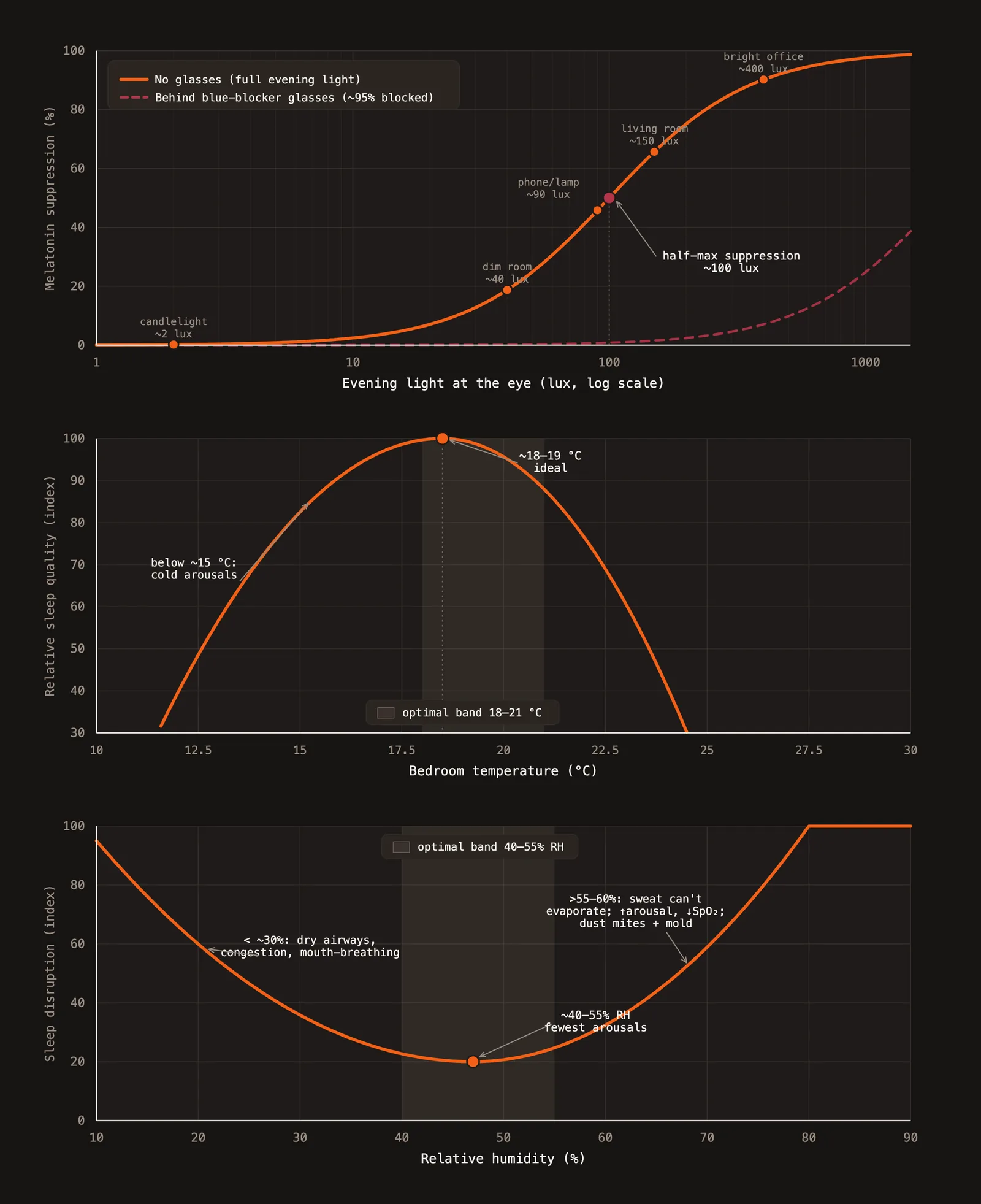
Starting with the humidifier, because it's the one people tend to underrate. The research clusters around 40 to 60 percent relative humidity as the range where sleep is best. The EPA says 30 to 50, the WHO and Sleep Foundation land closer to 40 to 55, with 60 as the ceiling. Both ends cause problems for different reasons. When the air is too humid, sweat can't evaporate properly, and since your body relies on that evaporative cooling to lower its core temperature at night, high humidity basically makes a given temperature feel warmer and harder to sleep in. Liu and colleagues found that higher relative humidity was linked to more arousals and lower blood oxygen saturation in both REM and non-REM sleep. On top of that, dust mites multiply fast above about 55 percent and mold becomes likely above 60, which is a slow allergy and airway load that shows up as congestion and small awakenings. The dry end is my real reason for owning one though. When the AC runs it pulls moisture out of the air, and dry air dries out the nose and throat, causes congestion and mouth breathing, and irritates the airways, all of which fragment sleep even when the temperature is perfect. So for me the humidifier is really the counterweight to running the AC all the time, keeping me around 40 to 55 percent instead of drifting dry.
The AC and holding a constant temperature comes next, because falling asleep is physically gated by your core body temperature dropping. Starting roughly two hours before bed, your body dumps heat through the skin and core temperature falls by about half a degree to a full degree Celsius, and that drop is part of the signal to sleep. A warm room blocks that heat dump, so you take longer to fall asleep and your sleep stays lighter. The research points to somewhere around 18 to 19 degrees as ideal, with a usable band of about 18 to 21. Go above roughly 24 or below about 15 and sleep fragments, with less REM and less deep sleep. REM is the stage that suffers most, because during REM your body basically switches off its own temperature regulation, so a room that's too hot or too cold hits REM the hardest. Muzet and colleagues tested a range of temperatures and found that the warmer it got, the shorter the REM cycles became. The reason I keep it constant day and night rather than just cool at night is that the swings themselves cause trouble. Thermal changes trigger body movement and micro awakenings even when the average temperature is fine, so holding one steady setpoint removes a whole category of disturbances. And at a large scale, a very big multi-country dataset covering billions of nights links warmer nighttime temperatures to more trouble falling asleep, so keeping it cool and steady is defending against something real.
And by far the biggest one, the Bon Charge blue-light-blocking glasses, because they act on the single strongest input I can actually control in the last hours before bed, which is the light hitting my eyes. Melatonin timing is run by a special set of cells in the retina that contain a pigment called melanopsin, and those cells are most sensitive to short-wavelength blue light around 460 to 480 nanometers. When they fire in the evening they tell the master clock in the brain to shut down melatonin production. The part most people underestimate is how little light it takes. In the landmark dose-response work by Zeitzer and colleagues, half of the maximum melatonin suppression happens at only about 100 lux, which is roughly dim living room light, and almost the entire jump from no effect to nearly full suppression happens between about 30 and 300 lux, so normal indoor lighting and screens are already well up that curve. A separate study by Gooley and colleagues showed ordinary room light before bed cut melatonin by about 71 percent and shortened how long it was secreted compared to dim light, and even a couple of lux of narrow blue light has a measurable effect. That's where the glasses come in. Amber blocking lenses cut the large majority of blue, and the pilot insomnia trial used lenses blocking around 97 percent. They strip out most of the circadian-relevant light while I can still read, use screens, and keep the lights on. The trials consistently show they protect evening melatonin and make people sleepier in the evening, which is exactly the effect I feel.
I do want to stay honest on this one though. The melatonin and circadian mechanism is very well established, but the effect on hard sleep numbers like how fast you fall asleep or total sleep time is more mixed across studies, partly because a lot of trials were small and used very different lens quality. Only lenses that block a lot of the blue actually cut the circadian signal in a meaningful way. So the glasses being my number one is really about them being the highest-leverage input for the lowest cost, plus the effect being obvious for me, rather than a promise of a specific bump in a sleep tracker number.
The way I think about how they stack is simple. The glasses start the signal by letting melatonin rise, the cool constant temperature lets my body act on that signal by dropping core temperature on schedule, and the humidity keeps that cooling working and keeps my airways calm. The glasses trigger it, the temperature is the gate, and the humidity keeps the gate clean.